

Whāowhia te kete mātauranga
Fill your basket of knowledge
Photo by Maciey Olszewski
Rats
Rats have a devastating effect on native wildlife and plants and also cause damage to property, crops, and human health. Trials have been conducted to build knowledge, and learn how to remove rats from Waiheke for good.
Why eradicate rats
Rats are destructive to our native flora and fauna, and a threat to health and property. They are also responsible for the extinction of many native species.
Rat trial results
Check out what’s been learned so far from the 2022 Ostend and Kennedy Point trials to Oneroa in 2023 and Surfdale in 2024.
Rat control DIY
Join a community group, or learn how to control rats yourself. There are many ways to make sure rat numbers are reduced.
Do you have a particular question about the rat trial programme? Have look at some Frequently Asked Questions, or just contact us on info@tekorowaiowaiheke.org.
Why eradicate rats?
There are many reasons to eradicate rats from our beautiful island. Rats are highly destructive to our native flora and fauna.
Through predation and competition for food sources, they are responsible for the extinction of many native species unique to New Zealand and the reduction of many others to levels where they can only exist on predator-free islands such as Motuihe and Te Hauturu-o-toi (Little Barrier Island).

Save our wildlife
47,000 native birds are killed by rats in New Zealand every day*.
Rats are omnivores and their varied diet means they impact native wildlife in many ways, by directly preying on them, and also by competing for food sources and preventing forest regeneration. A rats diet includes birds, chicks, eggs, seeds, snails, lizards, fruit, weta, plant shoots, and flowers
* Dr John Innes, Landcare Research

Prevent costly property damage
Rats can be destructive to property, by gnawing on plastic and wood, and leaving holes in walls, floorboards, electric cables, or water pipes! Rats often nest beneath building foundations in woodpiles and inside walls and ceilings.They can enter homes through just a 20 mm-sized hole or crack.
Winter is when rats are most likely to try and come inside when natural food supplies are at their lowest and the weather is cold and often wet.

Keep crops and food safe
Rats will eat almost every variety of garden vegetables and fruit, whether they are growing or in storage. Although both species are omnivorous (eating plants and animals), ship rats tend to eat more plants than Norway rats.
Compost piles are a favourite site for rats as they are warm in winter and contain a lot of food without having to go far from home. You will often find holes and tunnels in mulch piles where rats have made their home for the winter.

Rats can make you sick
Rats can transmit diseases by a bite or scratch, or just by contact with their droppings or urine. Some of the most common diseases transmitted to people by rats include:
Leptospirosis - a blood infection that can be transmitted from rat urine to humans. Signs and symptoms can range from mild (headaches, muscle pains, and fevers) to severe (bleeding in the lungs or meningitis).
Salmonellosis – a bacterial disease that can be caught by consuming food or water that has been contaminated by rat faeces.
Dysentery – a gastrointestinal disorder that causes abdominal pain and cramps.
Lymphocytic choriomeningitis (LCMV) – a viral infectious disease that is transmitted through the urine and saliva of rats, causing fever, malaise, lack of appetite, muscle aches, headache, nausea, and vomiting.
Mycoplasma – a type of bacteria known to cause respiratory problems and pneumonia.

Prevent an infestation
Rats breed extremely quickly, so addressing rat signs before an infestation occurs is important. A female rat typically births six litters a year consisting of up to 12 rat pups, although 5-10 pups are more common.
Rats reach sexual maturity after nine weeks, meaning that a population can swell from two rats to thousands in one year, with the potential to grow exponentially.
Rat species

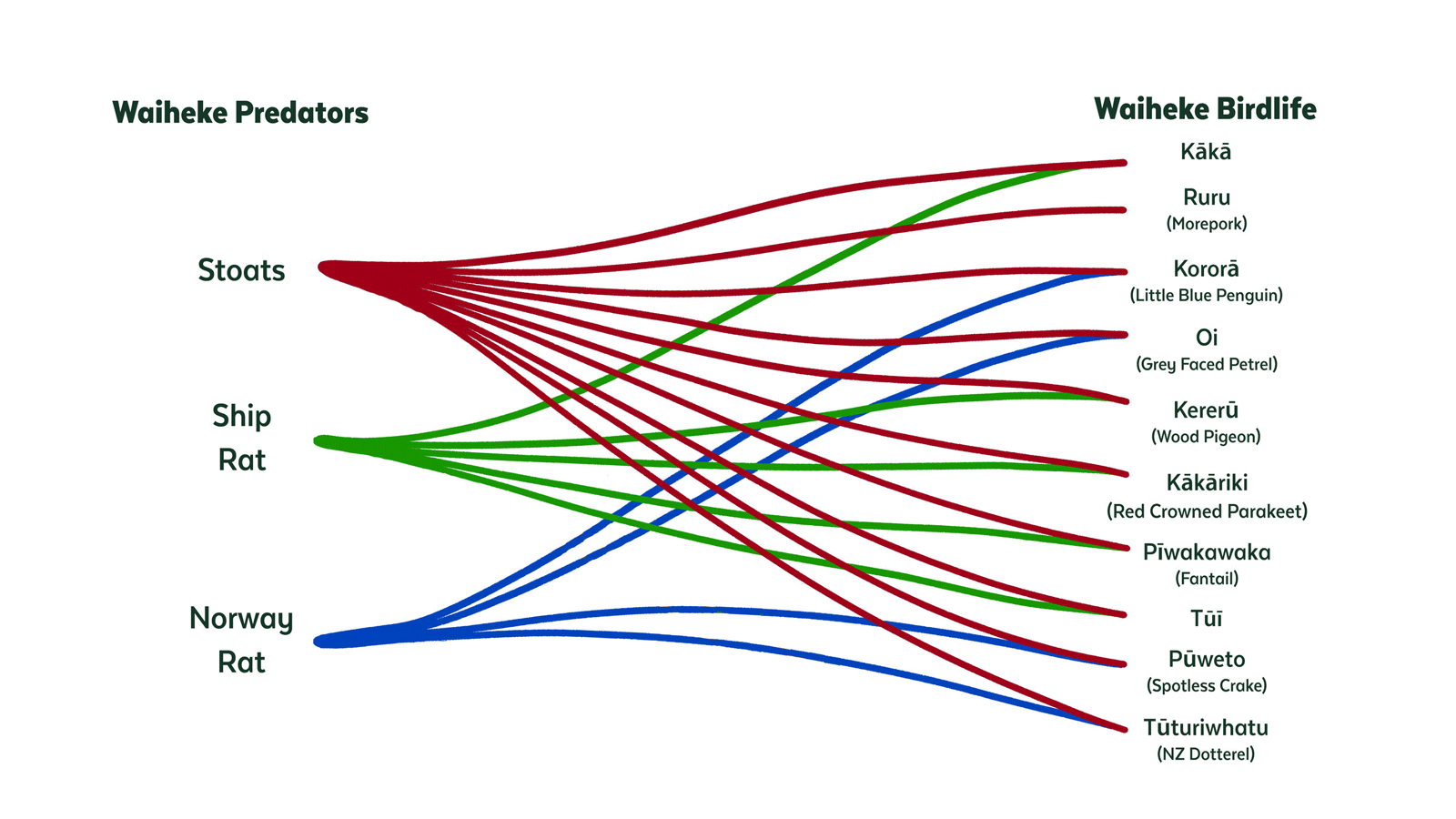
There are two species of rat on Waiheke - the ship rat and the Norway rat. With their different sizes and skills - together they have the assets to prey on every species of native birds.
The ship rat is most common and is a slender rat with a tail that is longer than its body, it has large ears and can be grey-brown or black. They are great climbers and target tree-dwelling birds like kererū, pīwakawaka, and tūī.
The Norway rat is larger with a short, thick tail which is shorter than its body and it has small ears. A Norway rats body is typically around 20cm long. They are large enough to kill burrow-nesting adult seabirds and eat their eggs and chicks.
View the below link to help you identify rate species:
Rats FAQs
-
Before we can eradicate rats from the whole island, we need to learn what tools and techniques will work best on Waiheke. The rat trials involve social research, monitoring and operations. It is extremely exciting that Waiheke has received funding for these trials– the first step towards an island-wide rat eradication.
-
The operational trial areas were carefully chosen to include various types of habitats, land use, residents, and industry.
-
Eradication is the removal of the entire population of an invasive species and ensuring they can’t come back, while control is the ongoing removal of rats from a site. Eradication operations methodically work through an operational plan with ever-increasing scrutiny to find and kill the last rat from the entire landscape while control operations repeat the same activity regularly, and forever.
Both eradication and control are important areas of work. The support, funding, and hours of work (often voluntary) controlling rats to low levels is critical for places where eradication isn’t yet possible, to hold invasive species at bay and prevent the extinction of our native species. While control operations reduce a risk to native species, eradications remove a risk to native species and therefore allow biodiversity to truly flourish.
-
The trial programme is a team effort that builds on the dedicated community and backyard rat control already happening on the island. There will be many opportunities for you to help during the project, including:
Rodent proofing compost bins
Removing piles of vegetation and debris from your property
Trapping rats at home
Volunteering with a community group
Learn to identify rat signs
Learn to observe changes in wildlife populations
-
There is very little risk to cats or dogs from the rat operational trials. No pets have been affected during the four trials that have so far taken place. The programme uses devices that are inside secure boxes, making it very difficult for pets to access them. In order for a pet to be affected, they would have to eat multiple, whole, dead animals.
-
The results of the trials will help inform the plan to eradicate rats from the whole island. - including timings and costs. The trials will also develop skilled workers, detection and response systems, and protocols, which will be critical to maintaining zero rats in the area. With information from the trials, Waiheke will be able to seek continued funding for an island-wide eradication and this is a key focus for the Trust.
-
No, 1080 is primarily used in large-scale control operations.
-
The scope of the Te Korowai o Waiheke project is limited to stoats and rats; cats are not included. Te Korowai o Waiheke encourages residents to be responsible pet owners and strongly supports the organisations on the island working in this area including Hauraki Gulf Forest & Bird and Waiheke Island Society for Care of Animals (WISCA).
-
To the best of our knowledge, there has never been possums on Waiheke Island.
-
Auckland Council and DOC run the Pest Free Hauraki Gulf programme in the Hauraki Gulf to raise awareness of steps boaties can take to protect our native wildlife when visiting pest free islands. This campaign is well-known to the boating community and Te Korowai o Waiheke will also be promoting this important initiative.
-
Many service providers such as Fullers, Island Direct and SeaLink ferries in the Hauraki Gulf have a Pest Free Warrant which requires that these operators have active biosecurity practices to either prevent pests getting on board, or if they do, are trapped in onboard devices. These operators also provide their clients with information in advance, as to what they need to do to comply with biosecurity requirements. We encourage passengers and transporters to use the ferry and barge companies that display a Pest Free Warrant. Auckland Transport also maintains a trap network and has cleaning stations at wharves for passengers to clean footwear to prevent the spread of weeds and kauri dieback disease.
-
Te Korowai o Waiheke is focusing on stoats and rats as these have the greatest negative impacts on native biodiversity. This also aligns with the Predator Free 2050 Limited initiative. However, it is acknowledged that the environment is a complex and interrelated web of activity. It can be helpful to work together with your neighbours to implement programmes to reduce other animal pests. Please ask Auckland Council for information about what you can do if you are concerned about a particular animal pest.
-
All Te Korowai o Waiheke staff, including contractors and volunteers, follow the approved kauri dieback prevention protocols prior to entry, which includes procedures such as avoiding kauri vegetation where ever possible, circumvention of the drip-line and strict hygiene standards when working in kauri areas.
Explore surveys and reports on the impact of eradication efforts on Waiheke’s wildlife and community.