
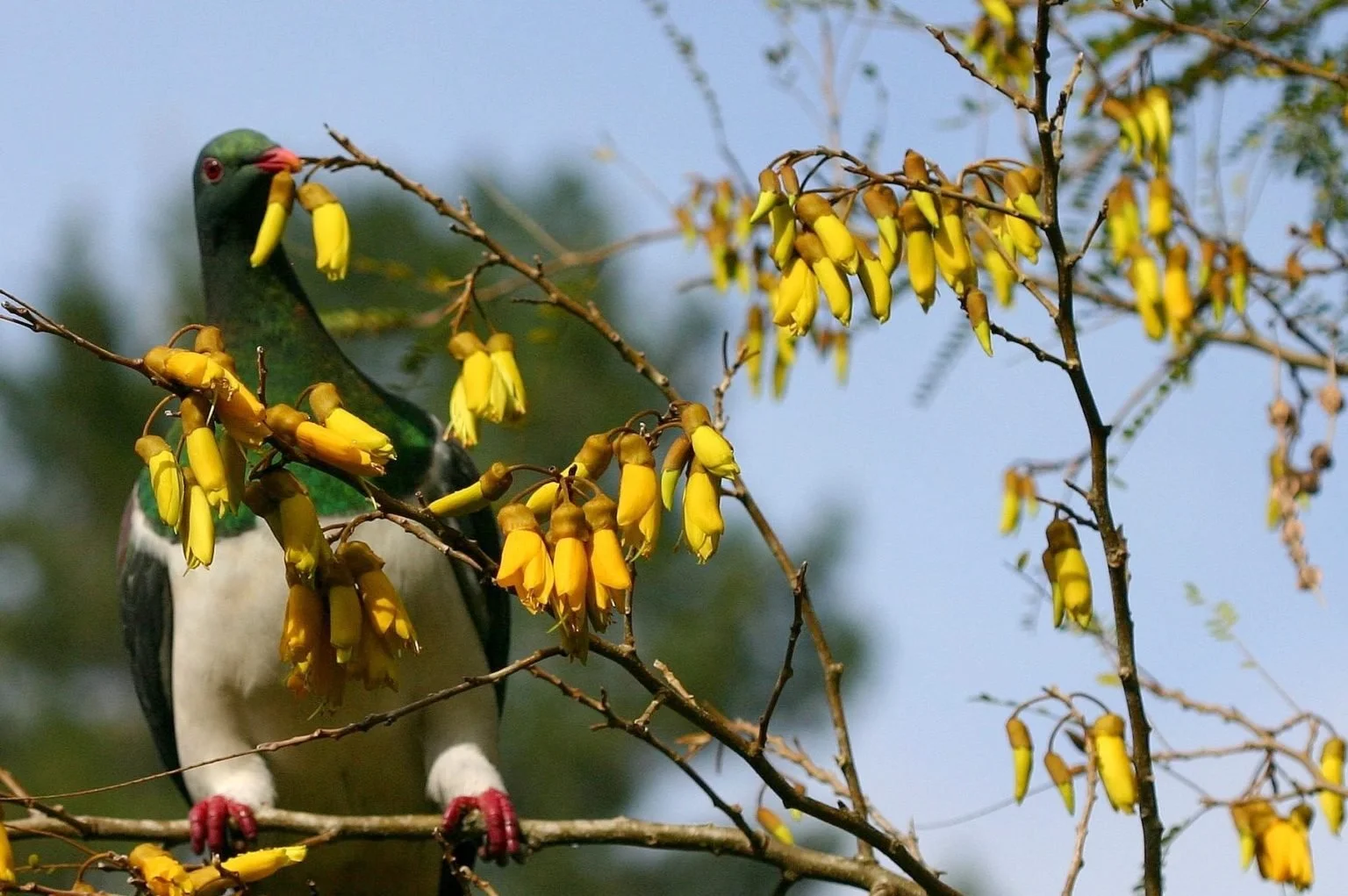
Kererū in a Kōwhai by Tony Foster
Spring has well and truly sprung on Waiheke. The tūī are working hard on their aerobatic displays, zooming through the bush at top speed. Kererū are doing their impressive dives as if they are about to fall out of the sky. The human residents too are coming out of hibernation and making their way towards the beaches.
My personal favourite harbinger of spring is the yellow bells of the kōwhai tree.
My love of kōwhai started when I was young and watching my dad carefully cut open each hard yellow seed husk with a pocket knife to allow germination in his plant nursery. He would give a tree to plant to each of the local kids on their birthday. I always chose kōwhai.
Kōwhai is one of only a handful of native trees in Aotearoa that lose their leaves, shedding them in late winter just before the flowers come. In a country where most of our natives look the same all year round, only sometimes distinguished by flowers or fruit, the kōwhai has always stood out to me as a tree that clearly marks the season.
In early spring, soft brown flower buds give way to bright yellow flowers. Those yellow flowers are lifesaving to our nectar-eating birds such as tūī and korimako as they arrive early in the season when food is scarce after the cold months. Tūī will get quite protective of their tree, with some dominant males so busy keeping other birds away from their precious nectar that they hardly get time to drink any themselves.
Traditionally, kōwhai blooming was important in maramataka, the Māori calendar. The emergence of flowers signalled the beginning of work for the new season, preparing soil in the māra (gardens) for the new crops to be planted, and giving rise to the whakataukī “I whea koe i te ao o te kōwhai?”, which translates to “where were you when the kōwhai was in bud?”. Kōwhai flowering also signals the return of whitebait to the streams, with tiny fish swimming upstream against the current while fallen kōwhai flowers float down. The kōwhai is also used in rongoā Māori (traditional medicine) to treat ailments from bruises to sore throats, but be warned: the kōwhai is poisonous and should only be used by experts who know how to use it safely.
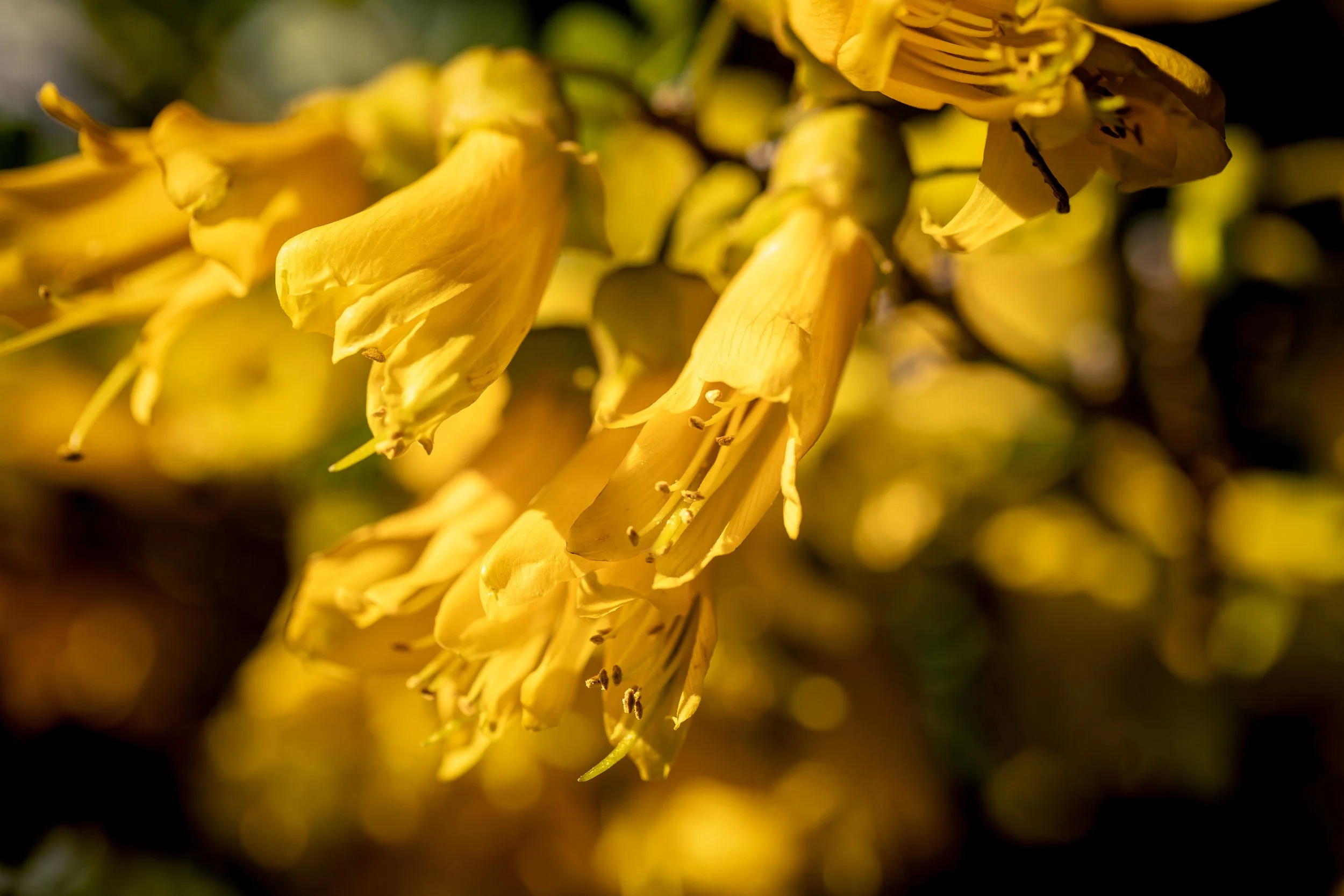
Golden Kōwhai Blossoms in Full Spring Glory
As the spring goes on, flowers begin to be interspersed with new green shoots; now it is the kererū’s turn to feast, as they pick the tender green leaves. The other week I walked past three kererū with bulging bellies, all perched in a tiny kōwhai tree and fast asleep.
Throughout the summer, the leaves will get thicker and darker, and by autumn the distinctive wiggly brown seed pods will break open to drop bright yellow seeds.
The kōwhai fixes nitrogen. The roots are covered in nodules which harbour symbiotic microorganisms, and these pull inert nitrogen out of the air. Once nitrogen has been fixed by the tree, it gets released back into the ground by yet more microorganisms and becomes available to all of the surrounding plants. In this way, the kōwhai feeds not only itself but also its neighbours.
As if feeding birds and neighbouring plants wasn’t enough, the roots of kōwhai also hold up stream banks, helping to prevent erosion during floods. Water will often carve out the space underneath the tree, creating holes for tuna (eels), but the tree stands firm. In return, the stream disperses the kōwhai seeds which are dropped from the banks. As the water moves the seeds along the rocks, the thick yellow shell surrounding the seed is broken, and when a seed washes up downstream, it will germinate. Each tiny yellow seed will grow into a tree that is, at once, a food source for birds, a calendar marker, a nitrogen fixer and a medicine. What an amazing tree!
— Written by Tilde Sorensen, Te Korowai o Waiheke Team Member