
Aotearoa’s Seabird Superhighway: Meet the Tākapu (Australasian Gannet)
Did you know the Hauraki Gulf is a globally significant seabird superhighway? While only about 365 of the world's 11,000 bird species are considered seabirds, a staggering one-third of all seabirds are found in Aotearoa, New Zealand.
Critically, the Gulf itself hosts 27 breeding species, including five that breed nowhere else on Earth. This includes two avian treasures: the endangered tara iti (NZ fairy tern), our rarest bird, and the takahikare raro (NZ storm petrel), which was famously rediscovered in 2003 after being thought extinct. (Information and inspiration courtesy of Chris Gaskin and the Seabird Trust)
Countless other seabirds also visit this vital region, but they are not as well known as forest birds – so let’s put a few in the spotlight…
3: Tākapu (Australasian gannet)
Few birds capture attention quite like the tākapu. With long, narrow wings and a pale golden head, they are a familiar sight above the Hauraki Gulf, gliding effortlessly before folding into a dramatic plunge, hitting the water at speed in pursuit of fish.
But beyond their spectacular hunting style lies a deeper story about how seabirds interact with the Gulf’s changing ecosystems.

Tākapu (Australasian Gannet) flying over Rotoroa Island in Hauraki Gulf, by James Gow Photography
A life between colony and ocean
Tākapu breed in dense colonies on rocky islands and headlands, including sites like Horuhoru Rock and Mahuki Island. These colonies are tightly packed, noisy, and highly social — a stark contrast to the vast ocean spaces the birds spend most of their time navigating.
During the breeding season, adults travel large distances from these colonies to find food, returning to feed their chicks. Where they go, and what they eat, can tell us a lot about the health of the marine environment.
Tracking work in the Hauraki Gulf has shown that birds from different colonies can use distinct foraging areas. Even when colonies are relatively close together, their feeding zones may be spatially separated, suggesting tākapu are responding to differences in ocean conditions and prey availability
.Like many seabirds, tākapu are also vulnerable on land. While their cliff and island colonies offer some protection, introduced mammalian predators such as rats, stoats, and feral cats can prey on eggs and chicks, particularly at more accessible sites. Ongoing predator control across the Hauraki Gulf plays an important role in protecting these colonies and supporting breeding success.
Following the food
Diet studies help paint an even clearer picture. Tākapu primarily feed on schooling fish like pilchards, anchovies, and jack mackerel, along with squid. However, the mix of prey can differ depending on where the birds are foraging.
Research comparing colonies such as Horuhoru Rock (inner Gulf) and Mahuki Island (outer Gulf) has found consistent differences in diet, with birds further offshore often feeding on more oceanic prey.
This raises an important question: Are birds shifting their behaviour to follow the food?
Changes in prey availability, likely influenced by fishing pressure, ocean warming, and wider ecosystem shifts, can affect where seabirds feed and how successfully they raise their chicks.
A changing Gulf
Long-term research suggests that not all colonies are responding in the same way.
Some inner Gulf colonies have shown notable declines over time, while some outer Gulf colonies have remained stable or increased. This variation may reflect broader changes in the Gulf’s food web and the distribution of prey.
As conditions shift, seabirds like the tākapu may need to travel further, adjust their diet, or rely on different feeding areas.
Because they sit high in the marine food chain, tākapu are considered indicators of ocean health, reflecting changes that are often harder to detect beneath the surface.
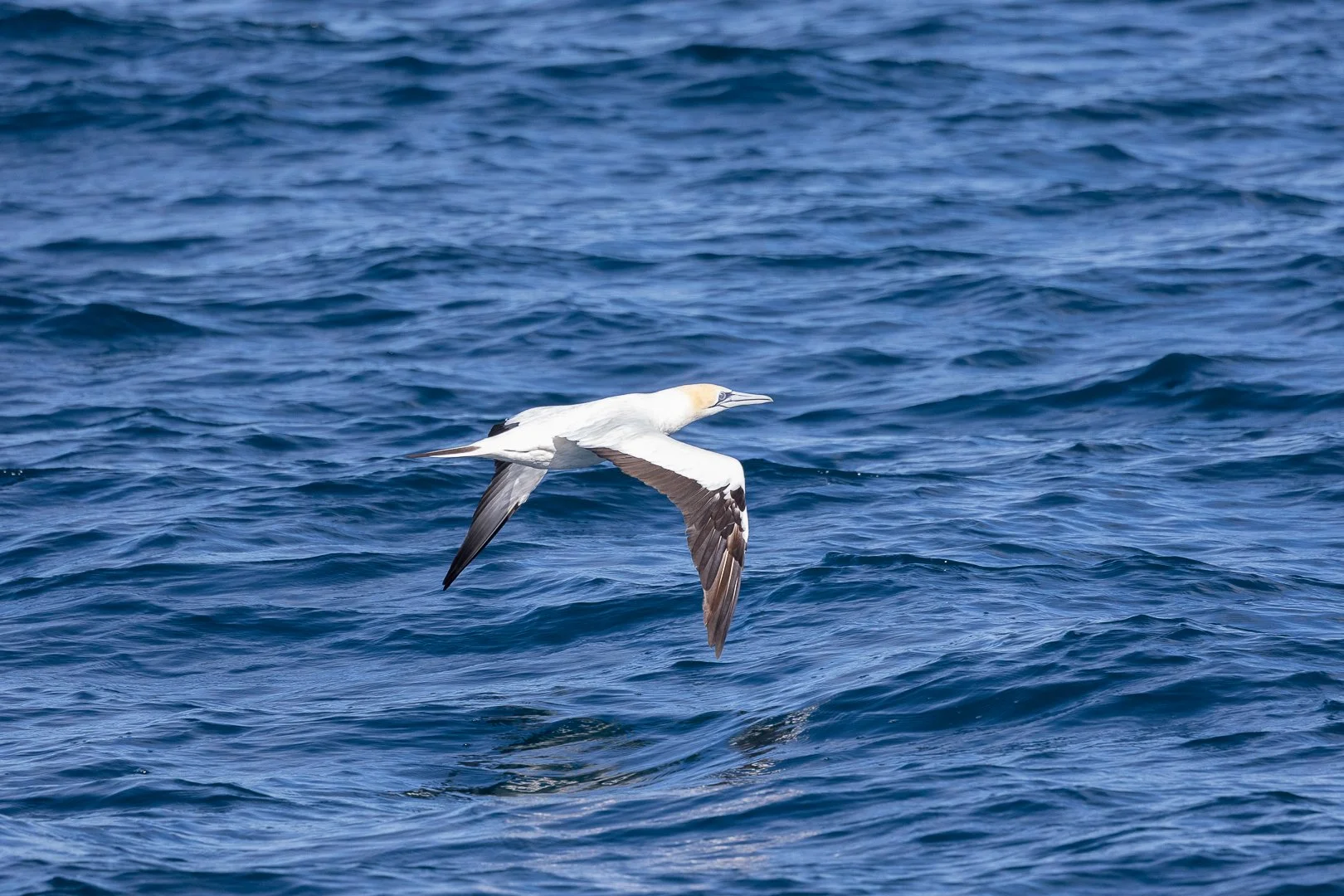
Tākapu (Australasian Gannet)
More than a spectacle
It’s easy to see tākapu as one of the Gulf’s most iconic birds — dramatic, visible, and charismatic. But they are also part of a much larger story.
Their movements, diets, and breeding success are all shaped by the health of the ocean around them. And in turn, they help us understand what’s changing, and where attention is needed.
So next time you see a tākapu diving offshore, it’s worth pausing for a moment.
That single plunge is part of a much bigger system, one that connects islands, oceans, and the future of the Hauraki Gulf itself.
Sources
Information and inspiration provided by Chris Gaskin and the Seabird Trust.
Additional information sourced from the Department of Conservation (DOC) and Birds New Zealand.
Research insights adapted from Rayner et al. (2021) on seabird trophic structure and long-term ecological change in the Hauraki Gulf.