
Nature's Jobs: meet the workforce keeping Waiheke running
Every native species has a role to play in a functioning ecosystem. Some spread seeds, some pollinate plants, some look after the soil, and others work the night shift keeping nature in balance. Most of this mahi goes unnoticed. But without these hardworking locals, our forests and wetlands simply wouldn't be the same.
Over the past few months we introduced ten of them on social media, one at a time. Here they all are in one place: the workers, what they do, and why every job matters.
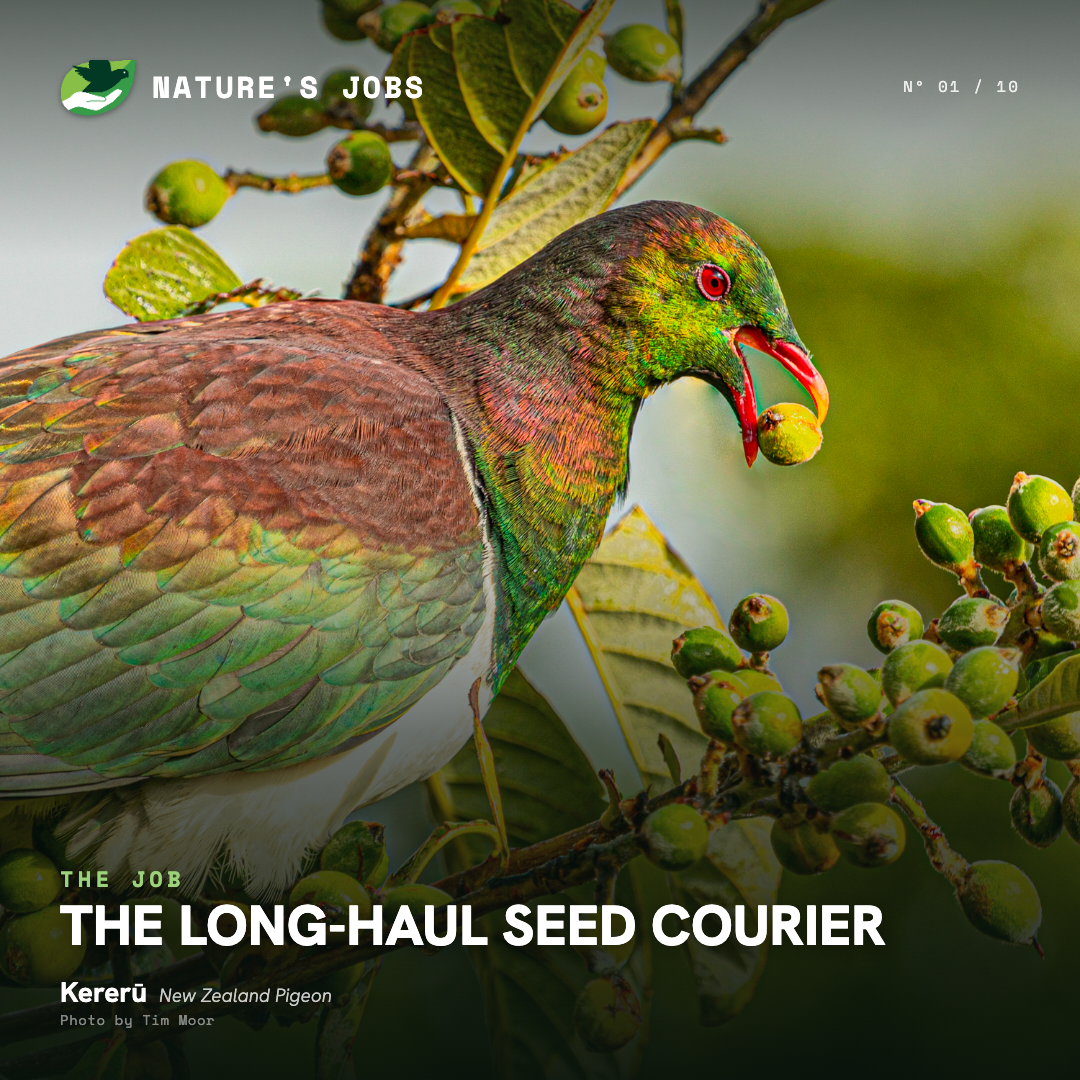
Kererū: the long-haul seed courier
The kererū holds a job with no backup. It is the courier for trees whose fruit is too large for any other bird to handle.
Tawa, taraire, karaka, miro, pūriri and matai all produce fruits too big for any other remaining native bird to swallow whole. The kererū doesn't peck at these fruits. It swallows them entire, sometimes up to 2cm across, then carries the seed inside its body for kilometres before depositing it far from the parent tree. Long-distance dispersal is the whole point. A seed dropped at the parent tree's roots competes with it for water and nutrients, while one carried a kilometre away has the space and light to become something new.
The moa once shared this job. When moa disappeared, within a few hundred years of human arrival in Aotearoa, kererū became the sole remaining large-fruited seed disperser in the forest, holding down the same volume of work with a fraction of the original workforce. Ecologists call kererū a keystone species, meaning its absence causes changes out of all proportion to its numbers. Forests don't collapse when kererū decline. The change is quieter than that. Certain trees stop spreading into new areas, and over decades the composition of the forest shifts in ways that become harder to reverse.
On Waiheke, kererū are present and visible. If you spend time near fruiting native trees you have almost certainly seen one, heavy-bodied and slow-flying, often looking mildly intoxicated from fermented fruit. A bird built to swallow large fruits whole needs to be large enough to carry them.
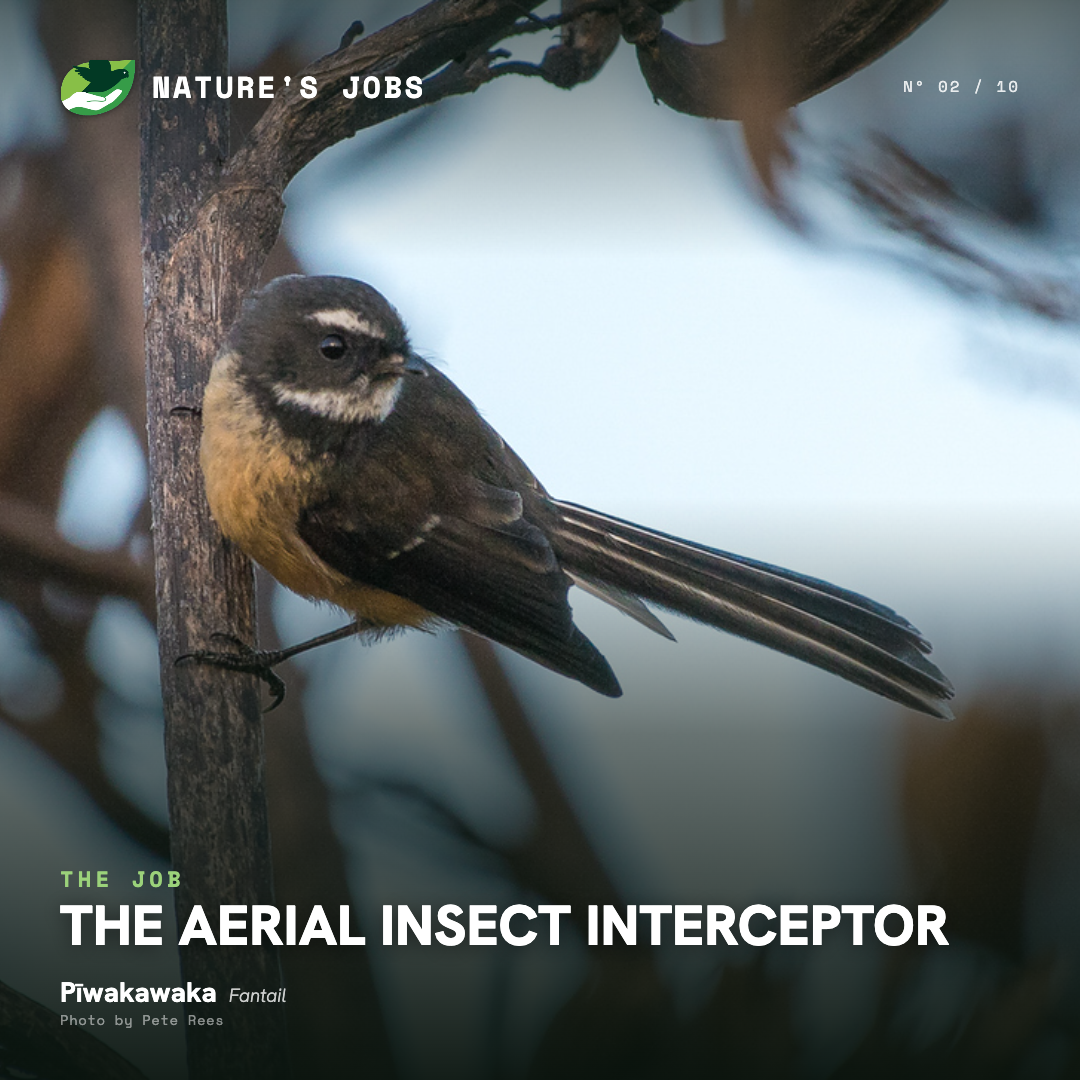
Pīwakawaka: the aerial insect interceptor
The pīwakawaka is the most approachable bird in New Zealand, often following you through the garden or the bush. It has absolutely no interest in your company, sorry.
When you walk through undergrowth, your footsteps disturb the insects living in the leaf litter and low vegetation. For a small, fast insectivore, that is not a nuisance but a hunting opportunity. The pīwakawaka has learned that large animals flush prey, and positions itself just behind you and to one side, intercepting whatever you stir up.
Slipstream hunting is one of three techniques it uses. In open vegetation it hawks, watching from a perch and launching at insects it spots moving nearby. In dense bush it gleans, working close to foliage and bark and picking insects from surfaces at close range. And everywhere, it fans that tail. The fan is a flushing technique, and the sudden spread and retraction of the tail feathers startles insects hiding in bark or leaf litter into movement, which makes them visible. The pīwakawaka does this reflexively and constantly, which is exactly what makes it so easy to spot.
Once airborne it takes moths, flies, spiders and wasps, feeding continuously through the day because a small body burns energy fast and needs constant refuelling. More predator-free ground means more pīwakawaka at work, and more pressure on the insect populations competing for the same space.
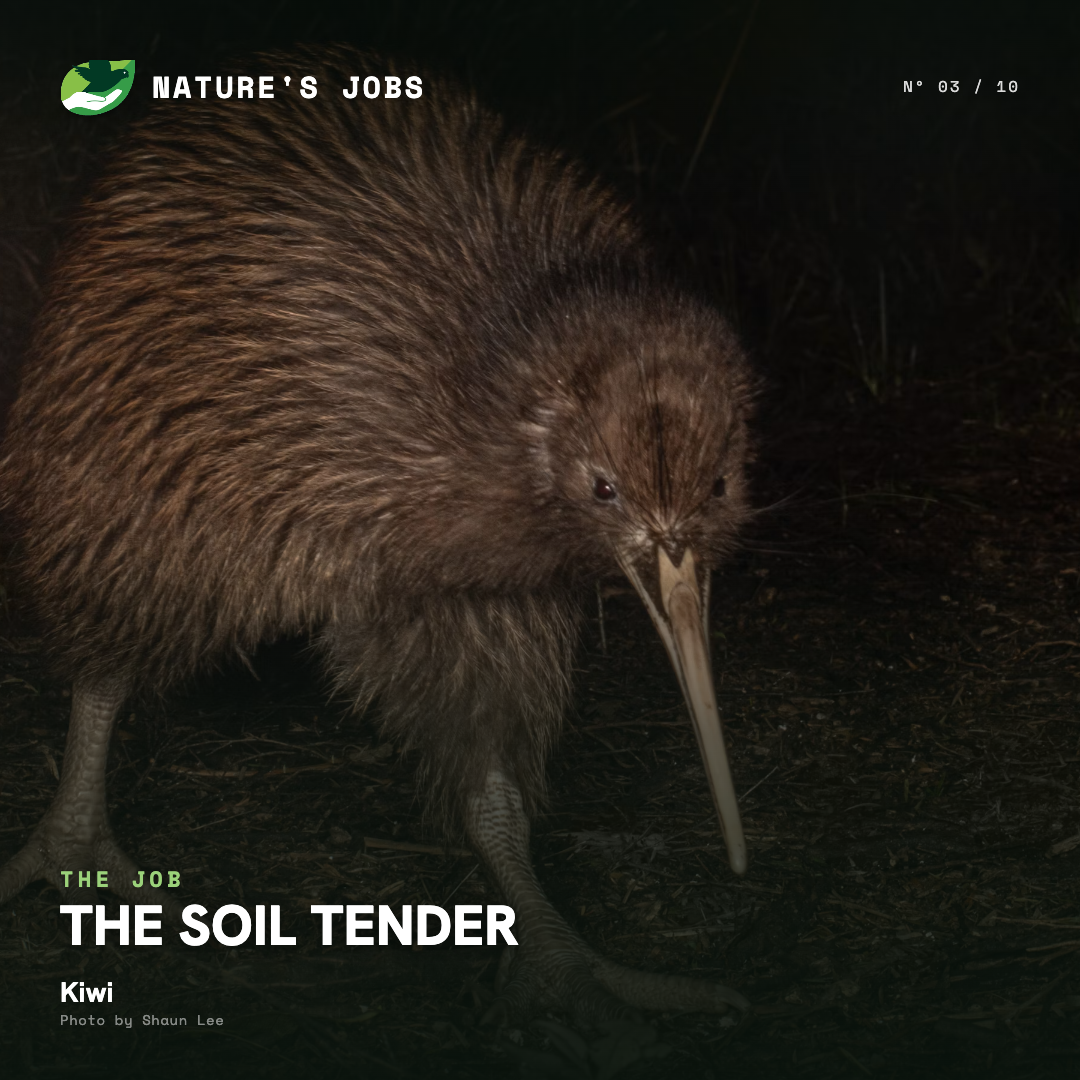
Kiwi: the soil tender
The kiwi's beak is unlike any other bird's in the world, with nostrils sitting at the very tip rather than at the base where almost every other species carries them. This lets the kiwi smell prey underground without seeing it. Long before ground-penetrating radar, the kiwi was using scent to locate worms, larvae and invertebrates beneath the forest floor.
That probing has consequences well beyond feeding. Each insertion of the beak aerates the soil, breaks up compaction, redistributes nutrients from deeper layers and creates micro-channels for water to move through. Over time those small, repeated actions add up to healthier and more permeable soil, which better supports the native plants growing above it.
There are 27 kiwi on Waiheke right now. That is 27 soil tenders across 92 square kilometres, carrying out thousands of tiny acts of restoration every single night.
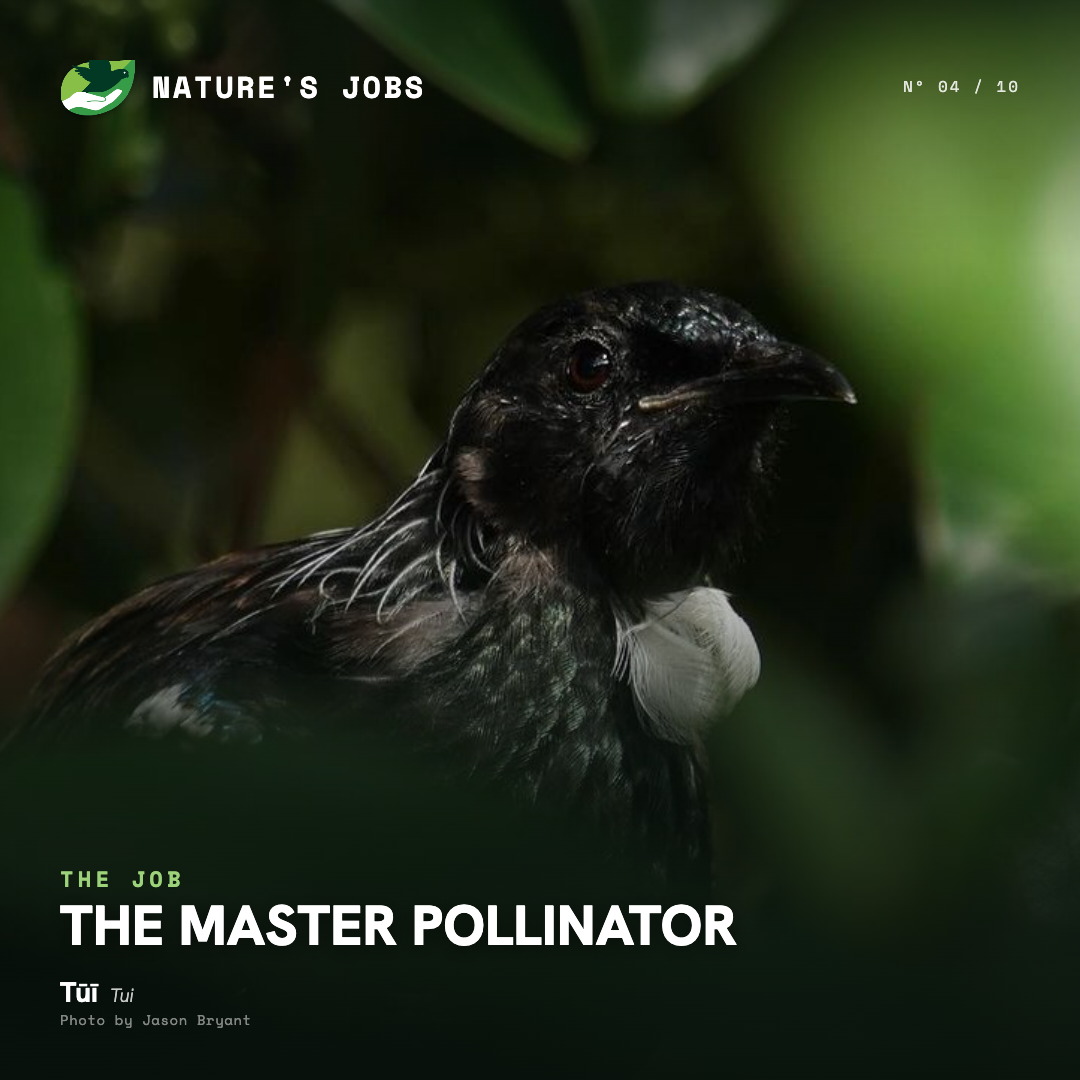
Tūī: the master pollinator
When a tūī pushes its beak into a pūriri flower to reach the nectar, pollen collects on the feathers at the top of its brow, the exact part of its head that meets the flower's anthers on the way in. When the tūī visits the next pūriri, that pollen is deposited on the stigma and cross-pollination happens.
None of this is incidental. Pūriri, rewarewa, kōwhai, pōhutukawa and rātā have, over millions of years, evolved flower shapes calibrated to a tūī's beak length and to the position of their own pollen-bearing parts. Some are shaped so specifically that insects cannot reach the nectar at all. Only the tūī, fitting the flower exactly, can do the work. That cross-pollination matters beyond the individual flower, because it creates genetic diversity across plant populations, and diversity is what makes native forest resilient to disease, drought and climate shifts. This is what master pollinator means in practice. The plant evolved to require exactly this bird.
The relationship runs both ways. Native plants produce plentiful, nutritious nectar to attract the tūī. The tūī gets the energy and the plant gets pollination. What looks like feeding is, from the plant's perspective, active recruitment of its primary worker.
Even the tūī's famous aggression serves the forest. When a tūī defends a flowering tree, chasing off silvereyes, rival tūī and anything else that arrives, it commits to visiting that tree repeatedly and thoroughly. More visits to more flowers within the same tree means better pollination coverage. The behaviour that looks antisocial is, ecologically, efficient.
The korimako, or bellbird, is part of this same workforce and lives on predator-free offshore islands including Tīritiri Mātangi and Motutapu. Its return to Waiheke is one of the outcomes a predator-free island could bring.
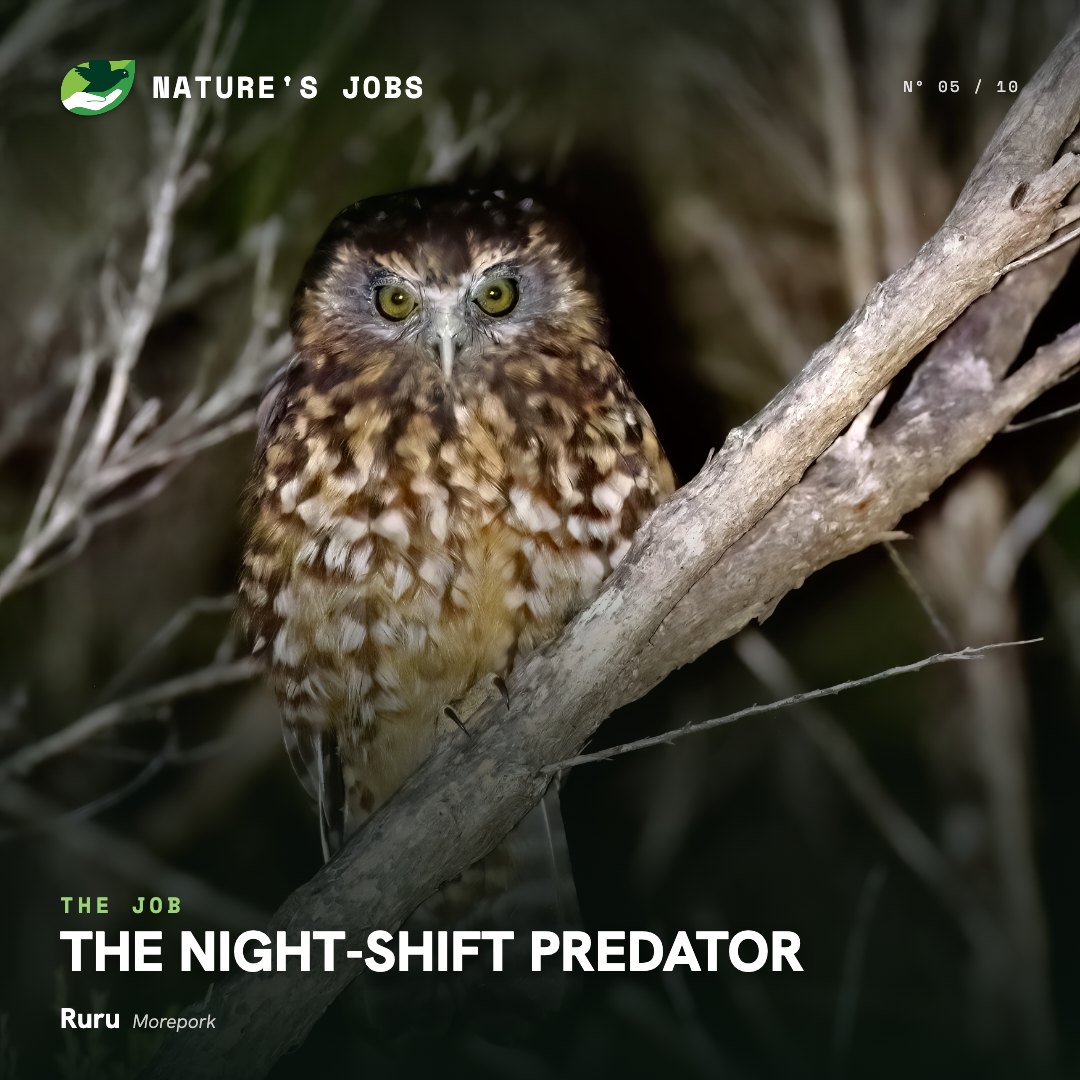
Ruru: the night-shift predator
After dark, when the last tūī has settled and the kiwi have begun their probing, the ruru begins its shift.
The morepork, ruru in te reo, its name onomatopoeic in both languages, is New Zealand's only native owl. It works the ecological shift that nothing else covers: the hours of true darkness. Its targets are the insects, worms, small lizards and occasional small rodents that become active once the sun drops. It hunts by sound and by the low-light vision those wide, forward-facing eyes are built for, perching silently and then dropping fast.
On Waiheke, ruru are present and audible after dusk in coastal bush. That double note carrying through the dark is the night shift on active duty, controlling insect populations, taking rodents when the chance arises, and holding a niche no other native species fills.
The complication is rats, which are also nocturnal. They hunt the same prey, and they raid ruru nests, taking eggs and chicks before they can fledge. A ruru pair nesting successfully in high-rat territory is doing so against the odds. This is the compounding logic of predator control. Fewer rats means fewer nests raided, which means more ruru surviving to breed, which means more night-shift hunting and more pressure on the nocturnal pests damaging the rest of the ecosystem.
If you hear that two-note call from the bush tonight, that is the night shift, working.
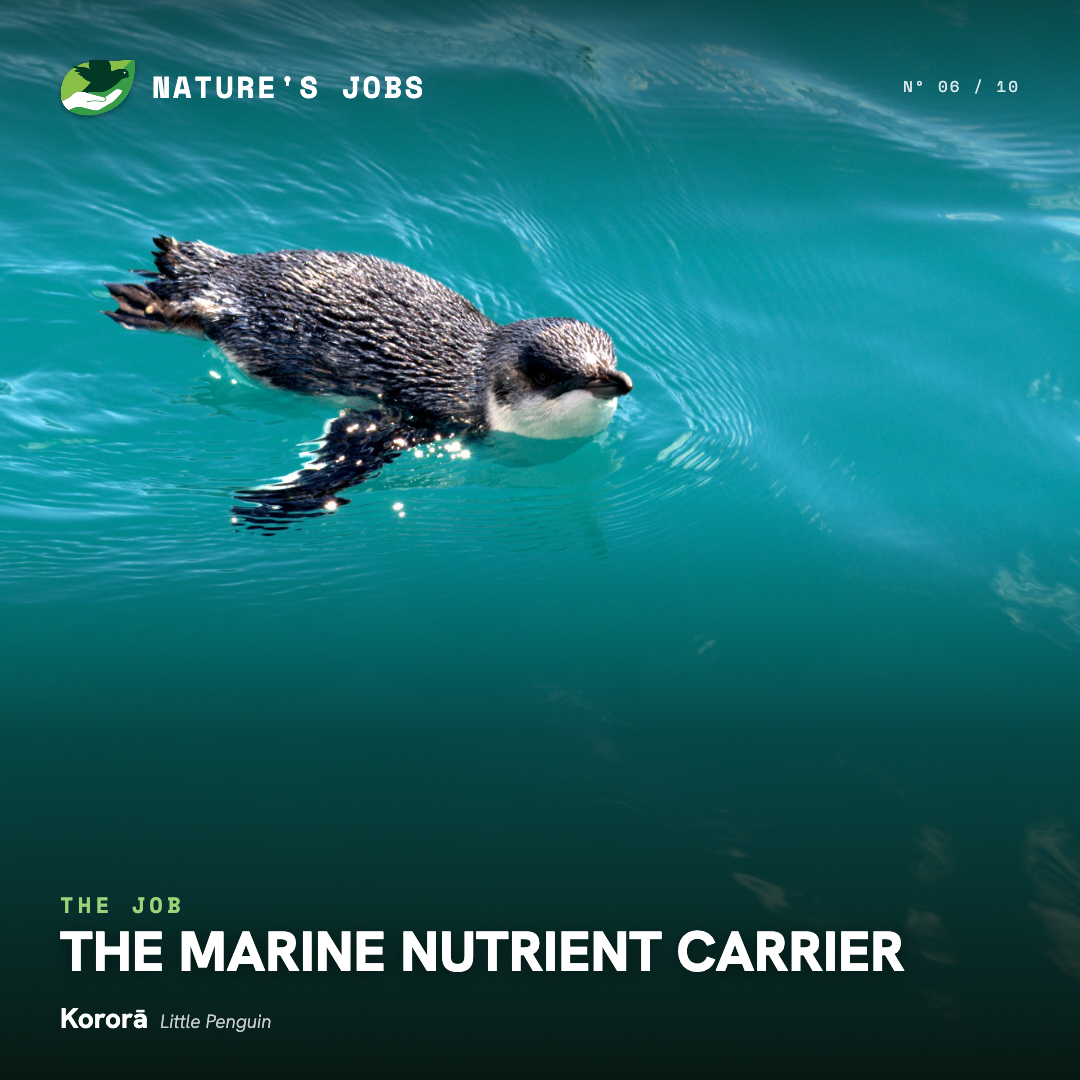
Kororā: the marine nutrient carrier
The forest at Waiheke's coast receives nutrients from the sea. Not from storms, but from birds.
Kororā spend their days offshore, diving for fish, squid and krill. The marine protein they consume contains phosphorus and nitrogen that are not naturally abundant in terrestrial soil. When they return to their burrows each evening those nutrients come with them, in guano deposited around the nest, in food regurgitated for chicks, and in the organic matter of the nests themselves.
Measured over decades, vegetation near active kororā nesting areas is more fertile than forest just metres away, and more diverse with it. Without seabirds bridging the gap between ocean and land, coastal forest is limited to what the land itself can produce.
Kororā are the world's smallest penguin at around 25cm tall, and they nest in burrows dotted along Waiheke's coastline. They are classified as at risk and declining. They come ashore after dark to avoid aerial predators. All introduced predators are a threat, but off-leash dogs are the leading cause of fatal attacks, because a frightened kororā freezes rather than fleeing and gives off a strong scent.
Every time a kororā makes it home safely, it is making the forest above it more productive.
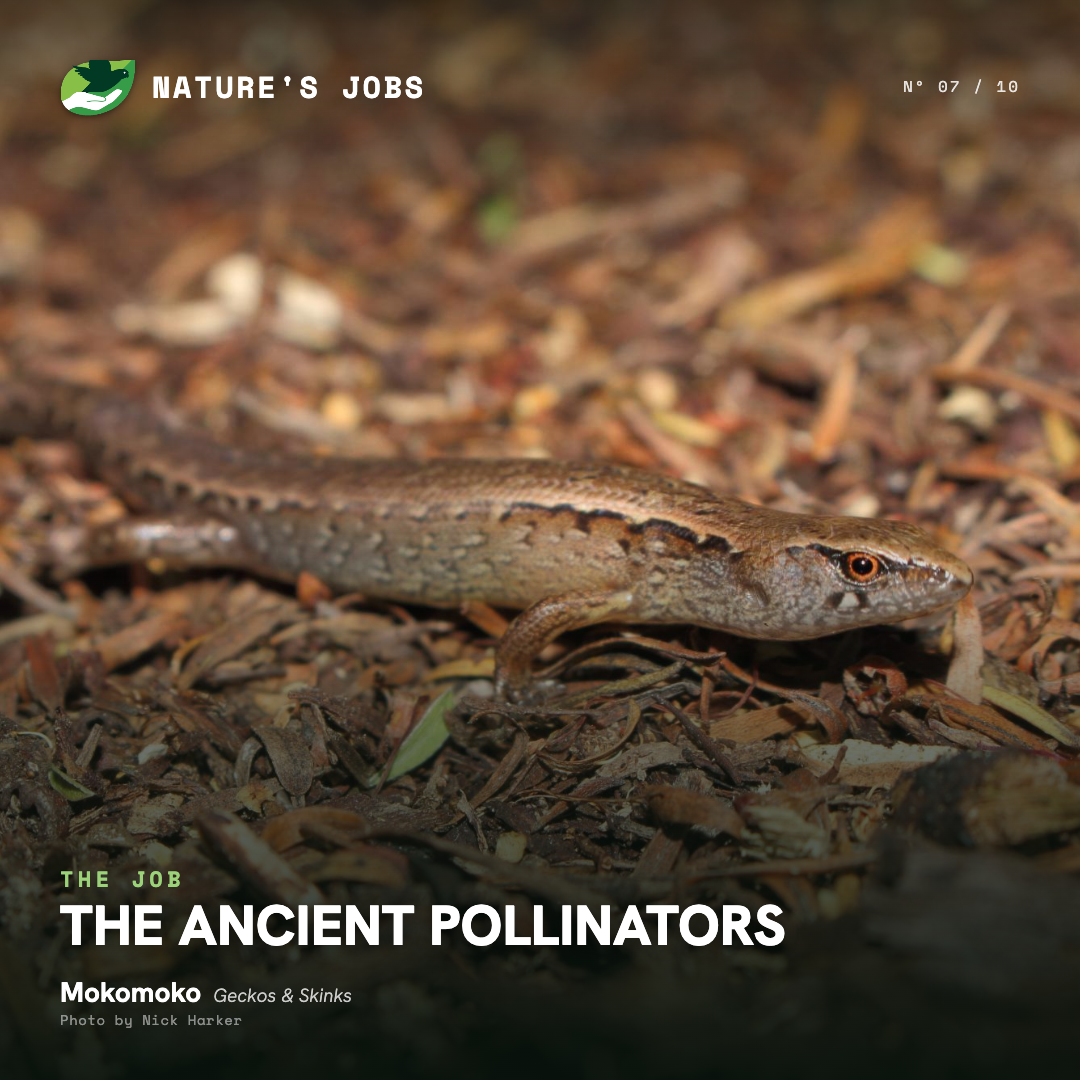
Mokomoko: the ancient pollinators
New Zealand had lizards before it had most birds, and some native plants still carry the evidence.
Mokomoko, our native geckos and skinks, visit the flowers of pōhutukawa, flax, southern rātā and cabbage trees, feeding on nectar and moving pollen from one plant to the next. In a country where birds tend to dominate the pollination story, it is easy to overlook that lizards have been visiting these flowers for far longer.
They are seed dispersers too. Geckos and skinks eat the fleshy fruits of native divaricating shrubs, including coprosma berries and muehlenbeckia fruits, and the seeds pass through the gut undamaged and still viable.
Some of these shrubs appear to have evolved specifically for the relationship, with fruit positioned low, at lizard height rather than bird height, in colours that reptiles detect well. That is an evolutionary signal. The plant adapted to attract a lizard, not a bird, and the adaptation dates from a time when this country's ecological workforce was dominated by reptiles.
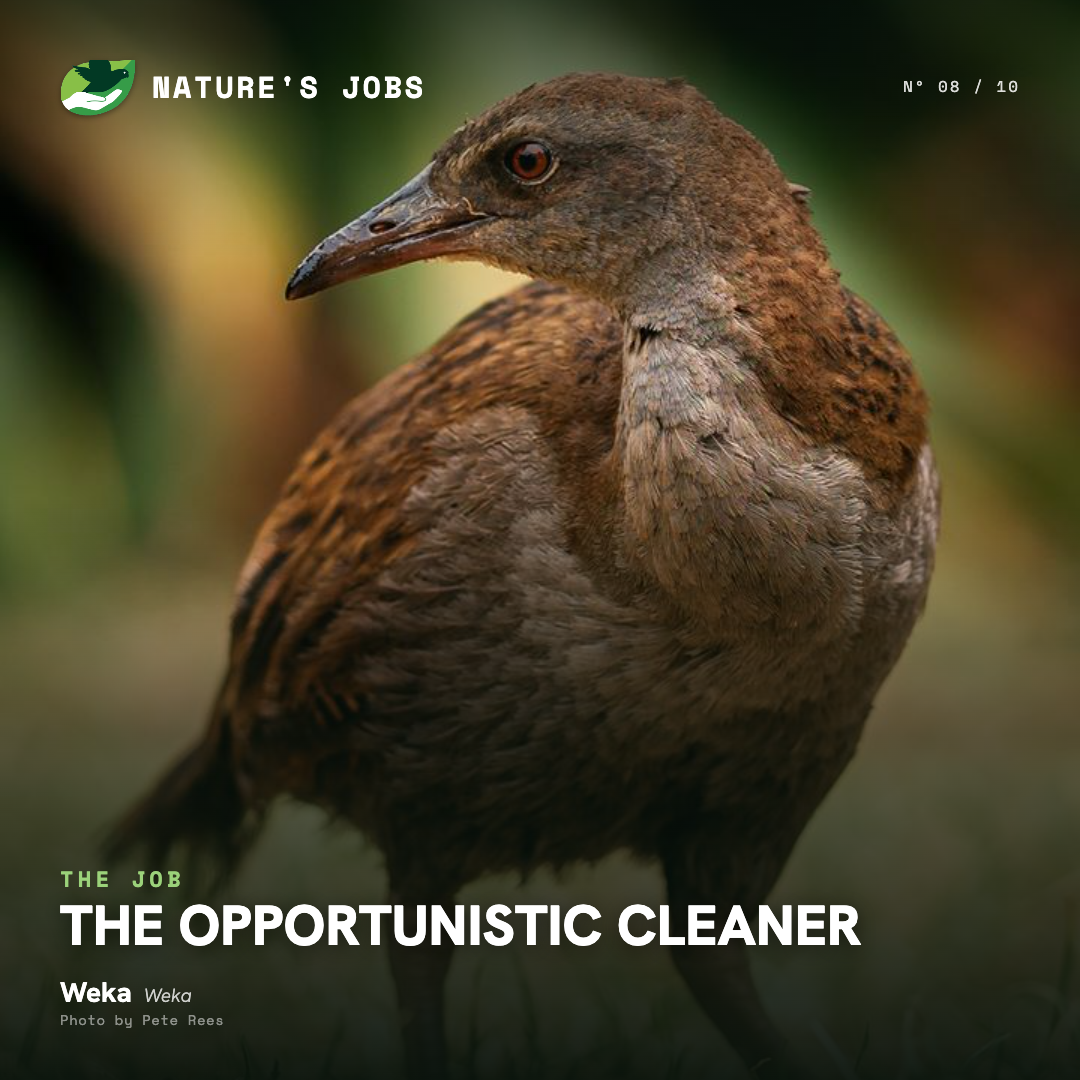
Weka: the opportunistic cleaner
Steve, Te Korowai o Waiheke's comms manager, noticed that when weka turned up at his place and started diligently patrolling the garden, rat detections stopped.
This is anecdotal rather than data, but the mechanism is plausible. Weka are bold, opportunistic omnivores that will eat almost anything they can overpower or reach: insects, berries, seeds, lizards, small chicks, bird eggs and the occasional rodent. In the gaps left by active pest control, a weka patrolling at night is doing real control work, finding rats that traps have missed.
Weka arrived on Waiheke's eastern end on their own terms. The most likely story is that they swam from Rotoroa or Kawau, since weka are surprisingly strong swimmers, though a boatie may have given them a hand. On Rotoroa, where weka are established alongside the island's restoration programme, native bird populations have been recovering strongly, which suggests that in a well-managed environment weka and other natives can share the same ground.
Weka are native, but the opportunistic cleaner also takes native lizards, ground-nesting eggs and chicks, and native invertebrates. That is the point the weka makes better than any other species here. Roles overlap, sometimes they conflict, and what holds it all together is millions of years of adjustment.
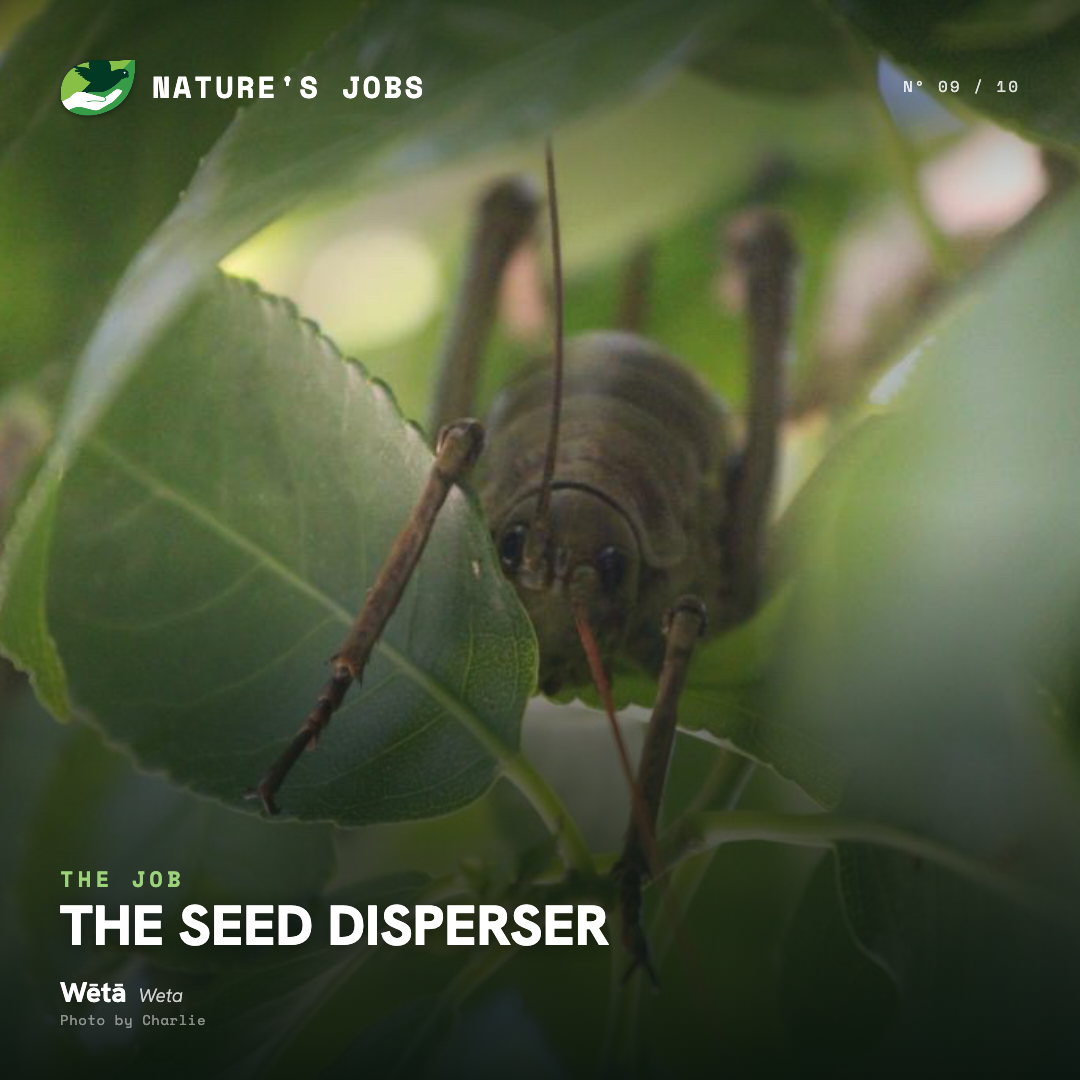
Wētā: the seed disperser
Most people know the wētā as the thing that makes visitors scream in bathrooms. Fewer know it is quietly doing the seed-dispersal work that mice do everywhere else on Earth.
New Zealand evolved without native land mammals. No mice, no rats. The jobs those animals do elsewhere still needed doing here, and wētā stepped in.
Research published in Science in 2006 confirmed it. Wētā eat fleshy native fruit and pass the seeds through their gut intact and viable. The seed lands somewhere new, away from the parent plant, ready to germinate. It is exactly what birds do in the canopy, except wētā do it at night, in the undergrowth, and they have been doing it far longer. Before people arrived, wētā were dispersing seed across a huge range of habitats, and in some of them they were the main ones doing it.
Then rats and mice arrived and the problem compounded fast. Introduced rodents eat the same fruit, prey on wētā at every life stage from egg to adult, and consume the same seeds the wētā would otherwise carry. Where rats move in, wētā move out, and in areas without pest control wētā are often locally absent.
The job didn't disappear when the rats arrived. It just got significantly harder to do.
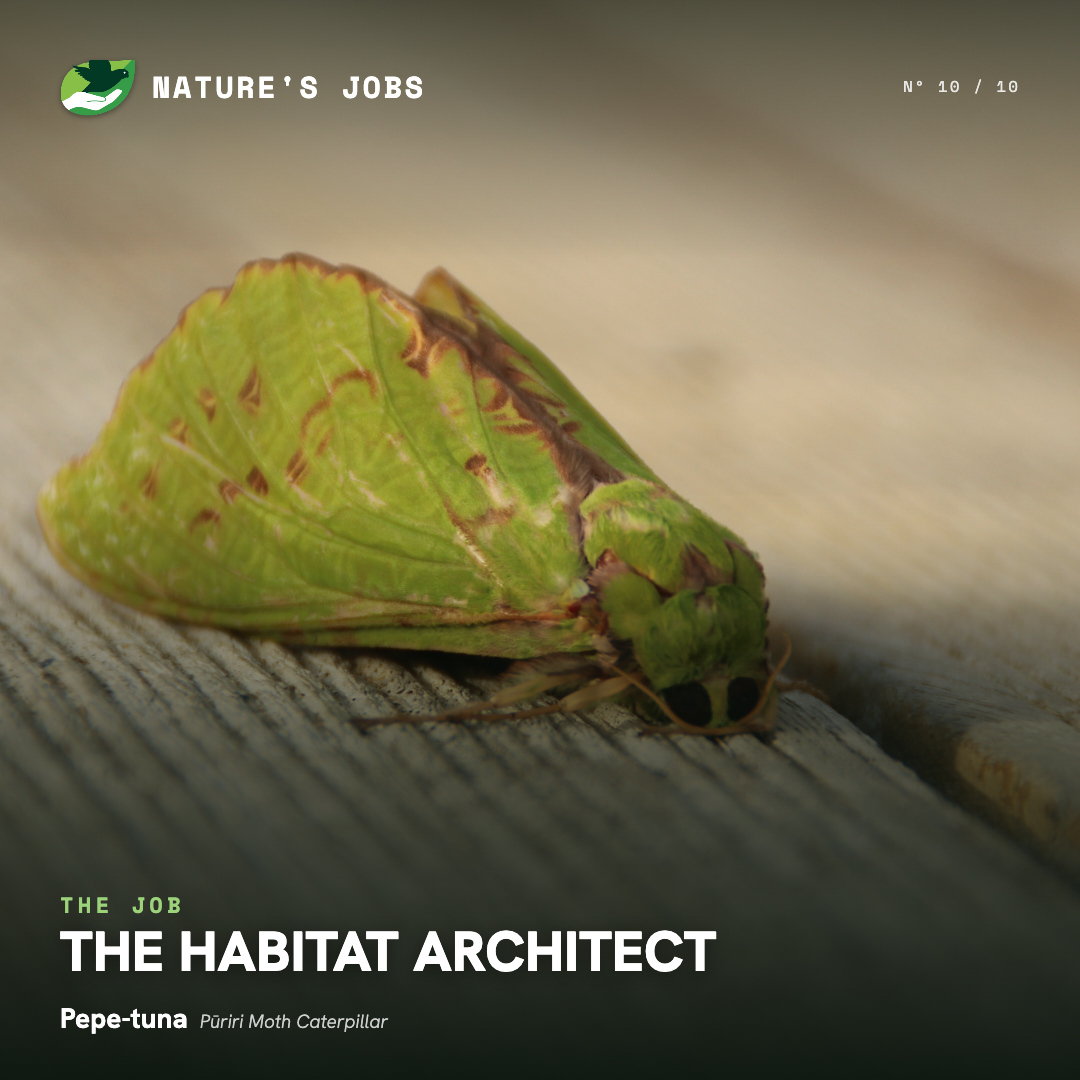
Pepe-tuna: the habitat architect
The adult pūriri moth lives for 48 hours. In that time it finds a mate, reproduces and dies. Adult pūriri moths have no functional mouthparts, so the whole of adult life is given over to one purpose and ends quickly.
The caterpillar is a different story. The pepe-tuna spends five to six years living inside the trunk of a living native tree.
After hatching, it crawls up the bark of a pūriri, putaputāwētā or makomako and bores inward, creating a 7-shaped tunnel through the living wood with a chamber sealed at the entrance by a membrane of silk and woody debris, camouflaged and kept warm. Each night it leaves the tunnel to feed on the bark and cambium around the entrance, maintaining its shelter as it grows.
After five or six years the caterpillar pupates and the moth emerges. The tunnel stays.
This is where the habitat architect's work becomes visible, in the species that cannot make their own cavities but depend on finding them. Mokomoko shelter in the tunnels, bats roost in them and small native birds nest in them. In a country with no woodpeckers and no other cavity-making invertebrate at this scale, pepe-tuna is the main provider of tree cavities in our northern forests, and the only moth or butterfly in Aotearoa doing this work.
Pepe-tuna is a North Island endemic, which puts Waiheke squarely inside its range. Pūriri trees on the island carry active tunnels right now. A slightly raised silken membrane at the entrance of a bore hole means the caterpillar is still inside, still building. Six years of construction for a 48-hour adult life, and the forest keeps the cavity for decades afterwards.
Why the whole workforce matters
Read these ten jobs together and a pattern shows up… Almost none of them have a backup.
The kererū is the only bird left that can move the largest seeds, the pepe-tuna is the only invertebrate making tree cavities at that scale, wētā took on a job that mammals do everywhere else on Earth, and mokomoko have been pollinating since before most of our birds existed. When one worker disappears, nothing steps in to cover the shift. The work simply stops, and the forest changes slowly enough that it can take decades to notice.
Every native species has a role to play - our job is to make sure they can keep doing theirs.